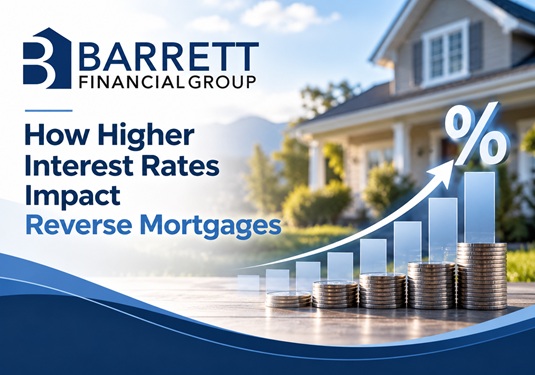
Reverse mortgages can help South Carolina homeowners age 62 and older access their housing wealth without making required monthly principal and interest payments. However, when interest rates rise, homeowners may wonder how those changes affect their borrowing power, loan costs, and retirement plans.
At Reverse Mortgage Specialists, we help homeowners understand how changing rates affect their options. While higher rates can reduce the amount available to borrow, they do not automatically prevent someone from qualifying for a loan.
The 10-year U.S. Treasury note just hit 6%. That figure illustrates a high-rate scenario, although it should not be treated as a verified current market quote. For homeowners considering a Home Equity Conversion Mortgage (HECM), understanding the relationship between Treasury yields and loan rates can help them make informed decisions.
How Do Interest Rates Affect Reverse Mortgages?
Interest rates affect how much money a homeowner may receive and how quickly the loan balance grows. Unlike a traditional mortgage, a HECM generally does not require monthly principal and interest payments.
Instead, interest accrues on the outstanding loan balance. The borrower typically repays the loan when they sell the home, permanently move out, or pass away.
However, borrowers must continue paying property taxes, homeowners insurance, and applicable property charges. They must also maintain the property and meet occupancy requirements.
Two types of interest rates play important roles in determining how these loans work.
What Is the Expected Interest Rate?
The expected interest rate helps determine the initial principal limit, which is the amount a borrower may access before applicable costs and existing mortgage payoffs.
For adjustable-rate HECMs, lenders generally calculate this rate using a long-term market index, such as the 10-year Constant Maturity Treasury (CMT), plus a lender margin.
When expected rates increase, the available principal limit generally decreases. As a result, homeowners may qualify for less money even when their age and property value remain unchanged.
What Is the Note Interest Rate?
The note interest rate determines how interest accrues on the outstanding loan balance. For an adjustable-rate HECM, the rate changes according to the loan’s selected index, adjustment terms, and lender margin.
For example, many adjustable-rate HECMs use the 1-year CMT or another permitted index. Fixed-rate loans follow different rules.
A higher note rate causes interest to accumulate faster. Therefore, homeowners in Charleston SC should consider the long-term impact on their remaining housing wealth.
Do Higher Rates Reduce the Amount Homeowners Can Borrow?
Yes. Higher expected rates generally reduce the initial principal limit for a HECM.
However, the actual amount available depends on several factors:
- Age of the youngest borrower or eligible non-borrowing spouse
- Current appraised property value
- Applicable FHA lending limits
- Expected interest rate
- Existing mortgage balances
- Closing costs and required financial set-asides
For example, a homeowner with a $400,000 property may receive a different borrowing amount when expected rates rise. The difference depends on the borrower’s age and other loan details.
Importantly, higher rates do not automatically disqualify an otherwise eligible homeowner. However, a lower principal limit may leave insufficient proceeds to pay off an existing mortgage.
How Do Reverse Mortgages Compare With Traditional Home Loans?
Traditional mortgages and home equity loans usually require monthly payments. When rates rise, those payments can become more expensive, especially for new borrowers.
A HECM works differently because borrowers can defer required monthly principal and interest payments while meeting their loan obligations.
This distinction can be valuable for retirees who want to reduce monthly expenses. However, interest and mortgage insurance charges continue to increase the outstanding balance.
Homeowners should also understand these important differences:
- Monthly cash flow: A HECM generally eliminates required monthly principal and interest payments.
- Loan balance: Unpaid interest and applicable charges increase the debt over time.
- Ownership: Borrowers retain title to their homes while meeting loan requirements.
- Remaining equity: A growing loan balance may reduce the amount left for future needs or heirs.
Therefore, homeowners should compare both immediate cash flow and long-term costs before choosing a financing option.
Can a Line of Credit Benefit From Higher Interest Rates?
 An adjustable-rate HECM may offer a line of credit that grows over time. The unused credit line increases at a rate tied to the loan’s interest rate plus the annual mortgage insurance premium rate.
When applicable rates rise, the unused line of credit may grow faster. However, this growth represents additional borrowing capacity, not interest earned in a savings account.
For example, a homeowner may establish a credit line and leave part of it unused. Over time, the available borrowing capacity can increase under the loan’s terms.
At South Carolina Reverse Mortgage Services, we explain how this feature may support long-term financial planning. However, faster credit-line growth does not cancel the higher interest costs on funds already borrowed.
Additionally, borrowers should understand that credit-line growth applies only to eligible adjustable-rate HECM products.
What Should Homeowners Know About Reverse Mortgage and Interest Rates?
When researching reverse mortgage and interest rates, homeowners should compare more than the advertised interest rate.
The lender margin, mortgage insurance premiums, closing costs, and loan structure can affect the overall cost.
Consider asking these questions before proceeding:
- Is the interest rate fixed or adjustable?
- How does the expected rate affect my borrowing limit?
- What fees will be added to my loan balance?
- How quickly could the balance grow?
- What happens if interest rates increase or decrease?
- How will the loan affect the equity available to my heirs?
These questions help homeowners understand both short-term benefits and long-term obligations.
Can Homeowners Lock in an Expected Rate?
HECM borrowers may receive expected-rate protection during the application process under applicable program rules.
For adjustable-rate HECMs, the expected rate used for principal-limit calculations may be protected for a specified period. Depending on the timing and applicable rules, borrowers may benefit from a lower eligible expected rate.
However, this protection does not necessarily lock the loan’s future adjustable note rate. Borrowers should ask lenders to explain the specific terms and expiration dates.
Should South Carolina Homeowners Apply When Rates Are High?
Higher interest rates do not automatically make a HECM a poor choice. However, they can change how much money homeowners receive and how much interest accumulates.
For some retirees, eliminating required monthly mortgage payments may improve cash flow. Others may prefer to wait, downsize, or explore alternative financing.
Before completing a reverse mortgage loan application, homeowners should review their current mortgage balance, expected retirement expenses, and plans for the property.
They should also compare offers from multiple reverse mortgage lenders. Different margins and closing costs may affect the overall loan terms.
Most importantly, homeowners should consider whether they expect to remain in the property long enough to justify the upfront costs.
Frequently Asked Questions About Reverse Mortgages
Do higher interest rates affect eligibility?
Higher rates do not directly change the basic age requirement. However, they may reduce available proceeds, which can affect whether the loan can pay off existing liens and meet required obligations.
Will monthly mortgage payments increase when rates rise?
A HECM does not require monthly principal and interest payments. However, higher rates may increase the loan balance more quickly.
Can interest rates decrease after closing?
Adjustable rates can decrease when the applicable index falls, subject to loan terms and rate limits. Fixed rates do not change.
Will rising rates reduce the amount heirs receive?
They can. Higher accrued interest may reduce remaining equity, although future property values and repayment timing also affect the outcome.
Is HUD-approved counseling required?
Yes. Borrowers must complete counseling with a HUD-approved HECM counselor before obtaining a federally insured HECM.
Interest rates are important, but they represent only one part of the decision. Your age, property value, existing mortgage balance, financial goals, and plans for your home also matter.
Call South Carolina Reverse Mortgage Services to discuss your options and request a no-obligation consultation. We can help you understand potential proceeds, costs, and responsibilities so you can decide whether this financing option fits your retirement plans.
Learn more about reverse mortgages on our Facebook page.
South Carolina Reverse Mortgage Services
Charleston, SC 29401
843-491-1436
www.reversemortgagespecialistusa.com/charleston
Areas Served:
Myrtle Beach, SC, Charleston, SC, Columbia, SC, Greenville, SC, Hilton Head Island, SC